REVIEW: On Falling
A sober, sapient snapshot of a capitalist cog becoming unstuck

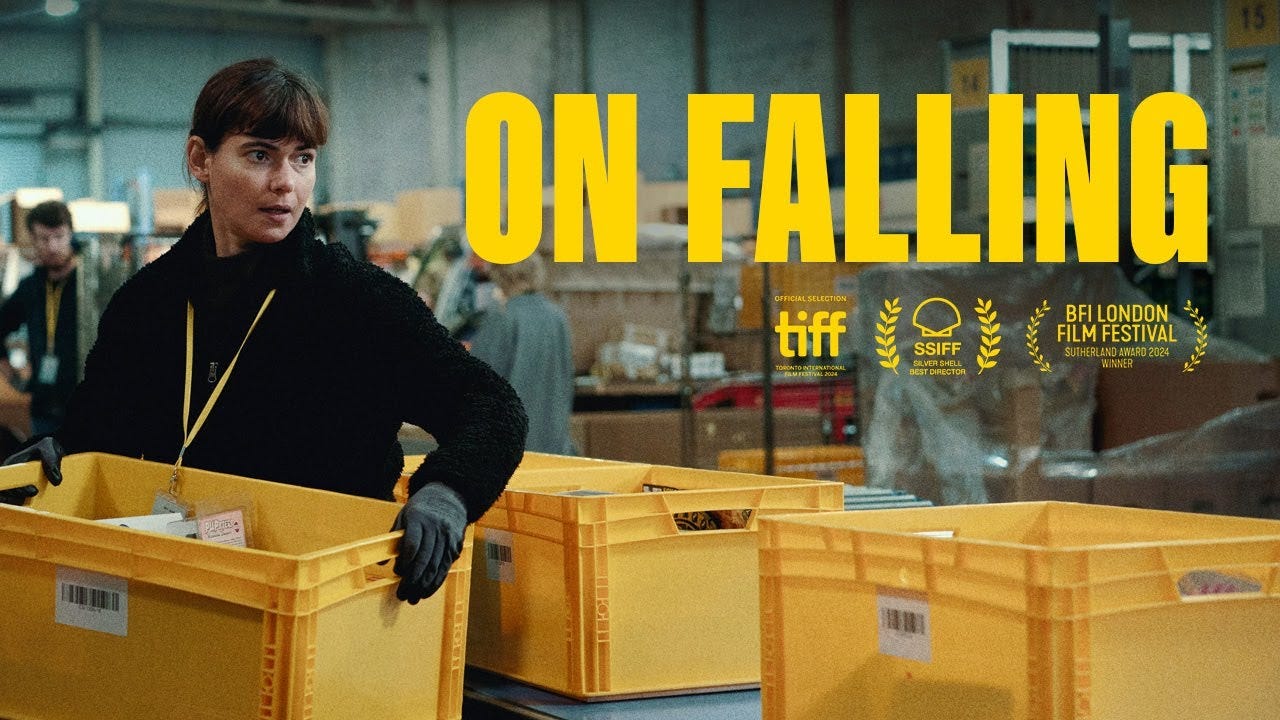
Oftentimes, the poor are reprimanded by society for their choices. A person on benefits having a takeaway is seen not as someone relieving the burden of cooking and subsequent washing up but as someone lazy. The word ‘choice’ occurs sporadically throughout Laura Carreira’s directorial debut On Falling, a sober, sapient portrait of a worker existing while situated within a gig economy. This is important to note, as it is the choices — or the appearance of choice — made by Aurora (a sensational Joana Santos) across the week before her payday that are the sinewy threads that pilot conflict within On Falling.
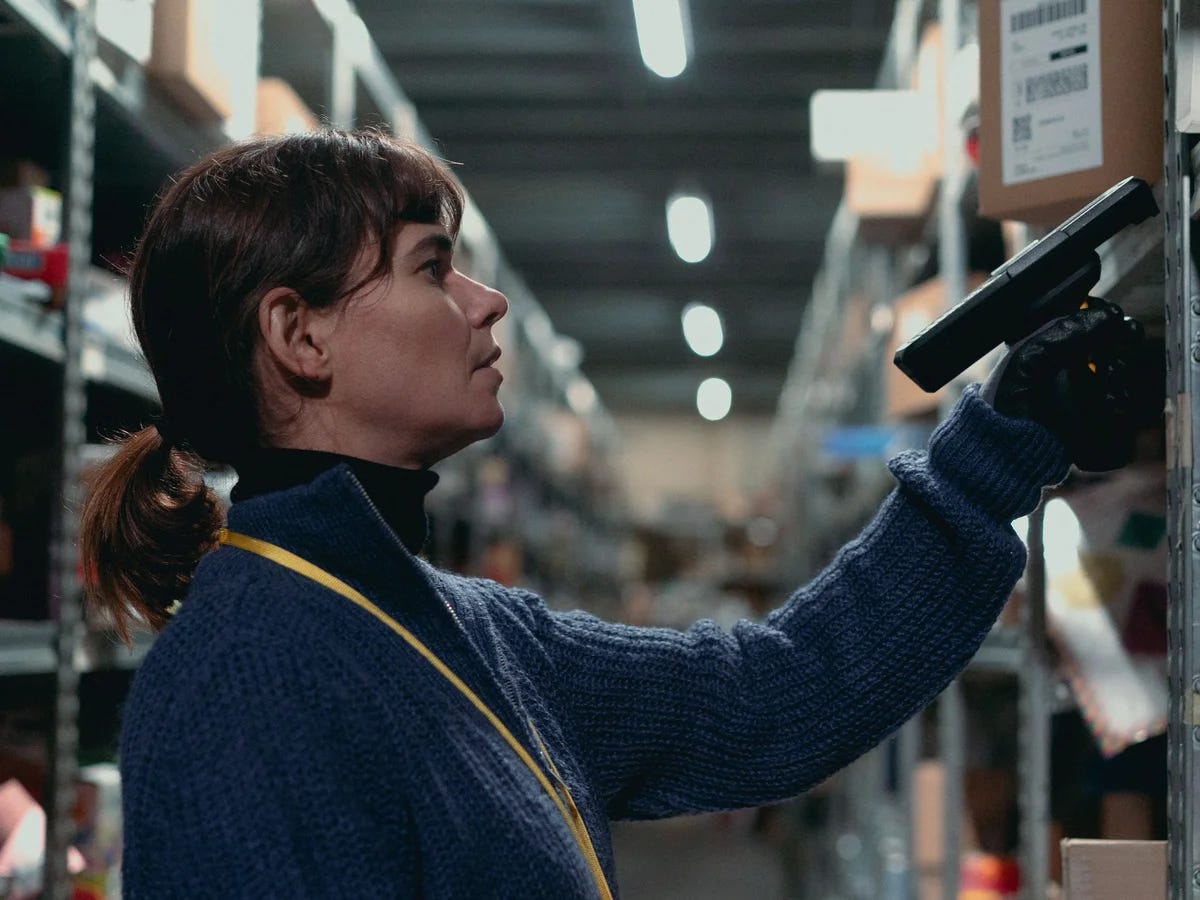
We first meet Aurora when she is working as a picker in a Scottish warehouse. The Portuguese migrant wields a handheld scanner which she aims firstly at a shelf, then at an item, and then a tub for the item to go into. Then a shelf, then an item, then the tub. Shelf. Item. Tub. If you think this sounds mechanical, and mind-numbing, you’d be correct. In On Falling, Aurora is a cog in the capitalist machine. She spends most of her time working between the industrial-sized shelves as the anemic lights flicker above her menacingly, while her scanner will perpetually beep should she take slightly too long to pull the trigger on scanning the next item sold by the company she works for.
When on break at work, she is sitting eating her dinner with colleagues that are constantly introducing themselves. These conversations are mostly insubstantial, usually discussing The Dark Path, a [fake] TV show they had watched the night before. The concept of water cooler talk has devolved from what was a casual few minutes spare during the day, and into a brief, shallow conversation that is as pointless as a Facebook post, all while trying to hoover up a less than nutritious meal before their brief break is up. The staff turnover is so vast that new faces spring up at nearly every meal, and one such face engages Aurora in a brief conversation before disappearing, only to become fodder for the staff’s harrowing small talk a few days later.
Aurora’s social life is also quite sparse as when not at work, or commuting to work, she is stuck in a malaise of existence. Her evenings consist of scrolling Instagram, falling asleep in her clothes because the space heater she has doesn’t work and making a meagre meal before starting the cyclical hell of being part of a machine that only values the output, and not the person behind it. As the film progresses, we see her dietary intake devolve. The first meal we see her eat at work is tomato pasta in a Tupperware. One of her next meals is from the canteen, and by the third act and a few days from payday, Aurora is stealing crisps and pilfering cupcakes intended for the entire workforce.
This is a straight-laced encapsulation of what statement Carreira is making with On Falling. Aurora’s first meal is saying that she has the emotional and physical energy to cook and portion out food, while her subsequent meals can be described as the meals of a crushed soul — the day-old cheese sandwich she consumes is perhaps the saddest part of the entire film — because her choices for ‘healthy’ food are taken away from her through a rising cost-of-living and her frazzled emotional bandwidth. The hours she works are unsociable and, as a migrant, her social circles are shrunk to solely interacting with her flatmates.
It matters little that the warehouse picking job in On Falling is emulative of grand conglomerate Amazon, as it is the very nature of shift work on or below the national living wage that fosters this toxic environment. This current generation — and the one shown within On Falling — is disillusioned by stagnant wages and rent prices, and jobs that prefer to put up suicide netting rather than change their profit-mongering ways. There is a significant lack of genuine welfare dedicated to the mental and physical health of the workforce in both the film and the world outside a reel of film.
This is apparent when Aurora requests time off for an emergency doctor’s appointment, where she is told to have booked two weeks in advance, with no attempt by the powers that be to facilitate this as a shift swap or alternative methods of reorganising the staff around it. The management in the warehouse seem as flustered and as stressed as Aurora is because this system is corrosive to empathy. Under capitalist structures, the cog only matters when it is doing its job. When you’re overworked and underpaid, you don’t have the energy for conflict, as shown by Aurora’s refusal to engage with her flatmates when she is required to top up the electricity meter. She replenishes these energy levels by scrolling Instagram, her social life limited to watching reels, vicariously living through social media.
It is this element of On Falling that appears to be accidentally clumsy. The film is predominantly about the de-moralistic tendencies of capitalism and the conversation that has occurred around it is focused on this. But the choice made by Aurora, where she pays her last £99 to fix her phone, leans the film towards becoming a discussion on social media obsession. As previously mentioned, her life outside of work is spent scrolling Instagram and it is solely her interaction with social media that audiences are made privy to. At this point, the film has only paid lip service to the idea that she is searching for another job but the jeopardy we are meant to feel towards Aurora in that moment is lensed through her inability to access her social media rather than missing a notification about a job interview. The choice to expedite the fixing of her phone, rather than wait, is where the film becomes thematically unstuck and dilutes its intended message in those moments. Later, when Aurora attends a job interview at the cost of losing a day’s pay, the magnitude of losing her phone emerges as subtext to this conflict.
The film is not a comprehensive diorama of the experience or reality of the struggle of the work force. As a freelance critic who works at a pool hall to taper off my debt , I noted that there is a distance made within the script of On Falling to discuss Aurora’s finances. There is nuance as to why people live paycheck to paycheck; the U.K has rising house prices, rising rent prices, rising fuel prices, rising food prices and a national minimum wage of £11.44 per hour. Far too little of these extratextual factors are shown in the film. Does Aurora have debt? Does she have student loans? Does she have family back home that rely on a portion of her wage? This is a story of a migrant, and yet any mention of Brexit is notably absent. Statuatory sick pay is £116.75 per week and a harsh reality for some (Contextually, average rent price in Glasgow is £1,202 per month, as per the office of national statistics).

One feels that this is because Carreira is being subtle for subtlety’s sake. On Falling is produced by Jack Thomas-O’Brien of Ken Loach’s production company Sixteen Films, and this can be felt in a large supporting cast of real workers from the area. This film is a mirrored version of what Loach might do with this material, where the left-wing auteur would perhaps discuss capitalism in overt terms — the film is a thematic sibling to Loach’s no-nonsense Amazon delivery driver tale Sorry We Missed You — Carreira’s film instead opts for a more modest snapshot how life is within the gig economy. On Falling is an indictment of capitalism, but only through the specific lens of audiences being able to project their own experiences of shift work in order to understand and appreciate the melancholic soul destruction on offer from the Portuguese director.

As a result, working-class people (like myself, who is writing this review on my break at my second job, one necessary in order to pay bills) will get much more out of On Falling than a privileged person may because it reflects the experience so astutely but without drama or scriptural context. This is simultaneously a feature and a flaw; the film feels hesitant to have any kind of big dramatic punch that would emotionally reinforce the anti-capitalist sentiment (especially as the picture uncouthly foreshadows a much more sinister finale) but this lack of ramifications or impact is the point made by Carreira here. Nothing will change because no one makes choices to usurp the system. There is no rousing speech or revolutionary uprising in On Falling because the film is a tragedy, even with the tiny flicker of hope allotted by Carreira in the final scenes. It is about the systematic degradation of spirit, where one can’t fight because they don’t have the energy to. It is a tragedy, one riding the coattails of capitalist failure.
Carreira – alongside the remarkable Santos, whose brittle and stirring performance is worth the entrance fee alone – captures the dehumanisation experienced by migrant workers from a distance, and with the same dispirited vigour that they feel. On Falling is no call-to-arms per se as it rebuffs any attempt to dramatically persuade audience; it is instead a time capsule of how miserable life is within capitalism in its current form.